 EN
EN  ZH
ZH  KR
KR  BR
BR  ES
ES  IN
IN  IL
IL  JP
JP  TH
TH 
Published:
June 15, 2026
Reading time:
5 minutes
FRESH BASIL IS a fragrant leafy herb from the mint family. Like many herbs, basil can harbor insects in its leaves, including aphids and Japanese beetles.
When using fresh basil – whole or chopped – follow these steps to ensure that it is clean and bug free:
•REMOVE the roots.
•RINSE under a strong stream of water.
•SOAK in water with Veggie Wash/liquid soap for 3 minutes. While soaking, rub each leaf between your fingers.
•EMPTY basin by removing basil with both hands (holding loosely) in small bunches and shaking them under the water.
•SOAK and agitate in clean water without soap for about 3 minutes.
•POUR the water through a fine mesh and check the cloth with a strong overhead light or lightbox.
•IF insects are found, repeat the process until the cloth is insect-free.
•IF, after checking the third time, there are still insects, the produce should not be used.
Even if one purchases pre-washed, bagged basil, the above procedure is still recommended, as the level of washing performed commercially is often insufficient to satisfy halachic requirements.
Pesto
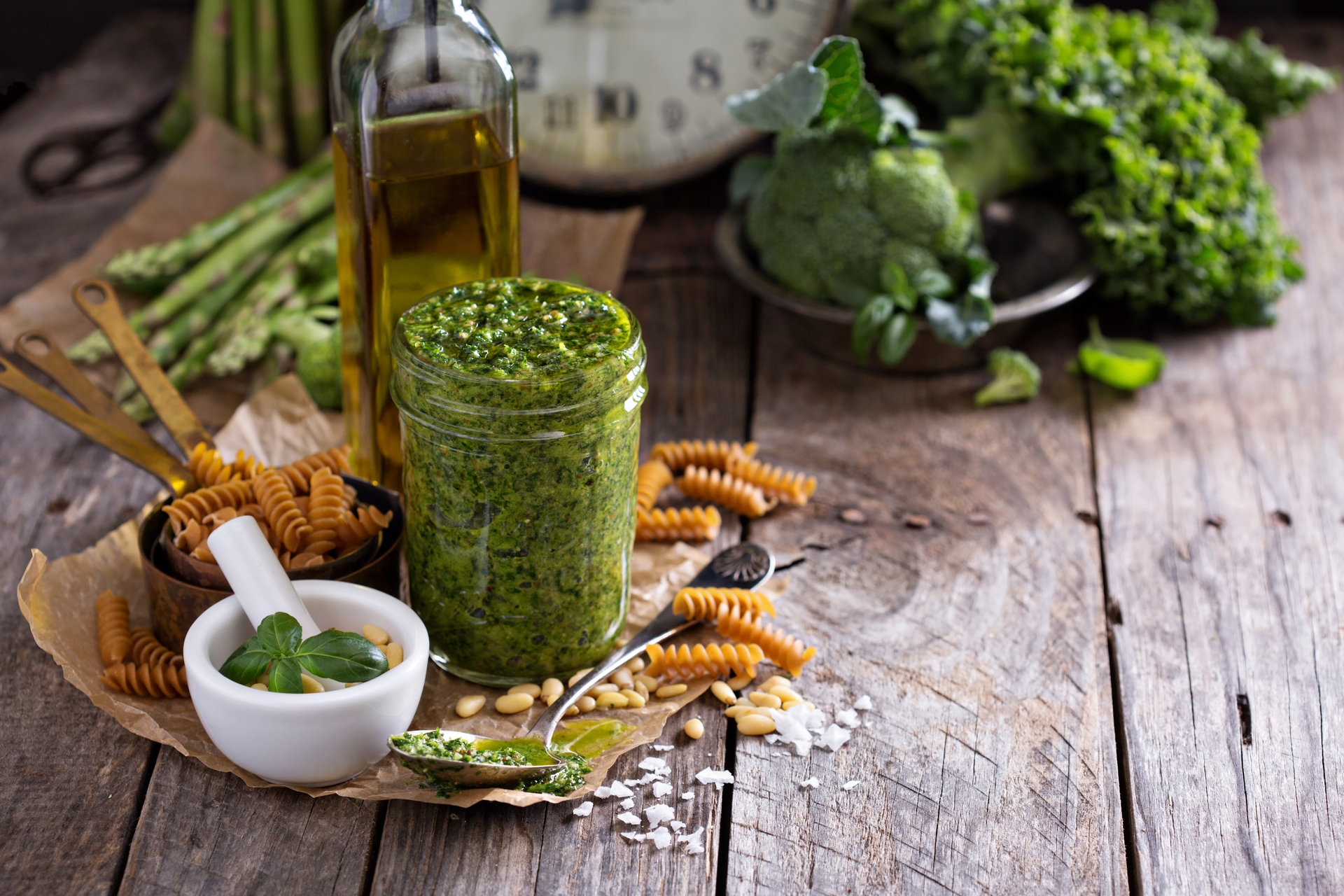
Pesto is a vibrant Italian sauce traditionally made from crushed basil, pine nuts, garlic, hard cheese (such as Parmesan), and olive oil. Of course, pesto can also be made pareve by substituting the cheese with a vegan alternative or simply leaving it out.
Typically, pesto is made by placing the above-mentioned ingredients into a blender and blending it essentially into a paste. Since the basil is completely blended, does that change the requirements for washing and checking it beforehand?
At first glance, it would seem that it does. The reason whole basil leaves must be thoroughly washed and checked is because of the concern for fully intact insects (beria), which are not botul. Once the basil is blended, however, any insects present would also be broken apart,
and once no longer intact, they become botul. For this reason, many people assume that no washing or checking is required when making pesto.
However, there is a principle in halacha of ein mevatlin issur l’chatchila — one may not intentionally cause an issur to become botul.
What is the person’s intention?
If one originally intended to use the basil whole or in pieces (for example, as a pizza topping or in a salad) and then discovers that the basil has a lot of bugs and is difficult to clean, one may not change plans and decide to make pesto solely in order to mitigate the bug issue. In such a case, this would clearly constitute mevatel issur l’chatchila, since the entire reason for choosing to blend the basil is to eliminate the halachic concern posed by the insects.
However, if one’s genuine intention from the outset was to make pesto, since the intent is not to nullify the insects, but simply to prepare pesto in the normal manner, would it be permitted?
The answer is that blending the basil into pesto l’chatchila would only be permitted if the basil is not considered muchzak for tolaim. In our experience, unwashed bunches of basil should be assumed to be muchzak for infestation — meaning that the likelihood of finding insects is greater than 50%. Therefore, even if one’s intention was always to make pesto, it is not permissible to simply blend basil without taking some action to address the infestation.¹
What Needs to Be Done?
Since in this case there is no need to guarantee that absolutely no insects remain, because any insects present will ultimately be blended and become botul, one does not need to perform the full washing and checking procedure described above. Rather, a thorough rinse of the leaves under strong running water is sufficient.
The rationale is that such a rinse is enough to remove the status of muchzak b’tolaim and reduce the concern to, at most, a safeik. Once the basil is no longer presumed to be infested and there is an equal possibility that insects are present or absent, the concern of ein mevatlin issur
l’chatchila no longer applies (at least with respect to an issur d’rabbonon).
This rinsing process is important, and care must be taken to ensure that all the leaves are rinsed thoroughly. If the basil is tied together in bunches, one should untie it and separate the leaves somewhat so that the water can properly flush out any insects trapped in the middle. This is especially important when washing large quantities of basil. Great care must be taken to ensure that all the leaves are thoroughly and evenly rinsed. If one is using bagged prewashed basil, no action is required, and one may go ahead and make the pesto even without rinsing it at home (as it is already rinsed).
It is important to note that the above applies only when using a sufficiently powerful blender that will thoroughly grind the basil into a smooth mixture. If the blender is not powerful enough and small pieces remain, this approach will not help, since there is no guarantee that any small
insects remaining in the basil will be broken apart during the blending process.
B’dieved, if one prepared pesto without rinsing the basil at all, there are Poskim that maintain that the pesto may nevertheless be eaten by everyone, even though one was not permitted to proceed in this manner l’chatchila. This is true provided that the first condition discussed above is met — namely, that the person’s intention in blending the basil was not specifically to nullify any insects that might be present, but rather to prepare pesto in the normal manner.
1 In our case, min haTorah the insects are botul, it’s only d’rabbonon that they are not, on account of it being a beria.