 EN
EN  ZH
ZH  KR
KR  BR
BR  ES
ES  IN
IN  IL
IL  JP
JP  TH
TH 
Published:
February 17, 2026
Reading time:
3 minutes
KASHERING MUST MIRROR the way the non-kosher taste was absorbed—k’bolo kach polto. If the absorption occurs through direct flame, kashering requires fire (libun). If absorption occurs through hot liquid, kashering is done with hot liquid (hagalah).
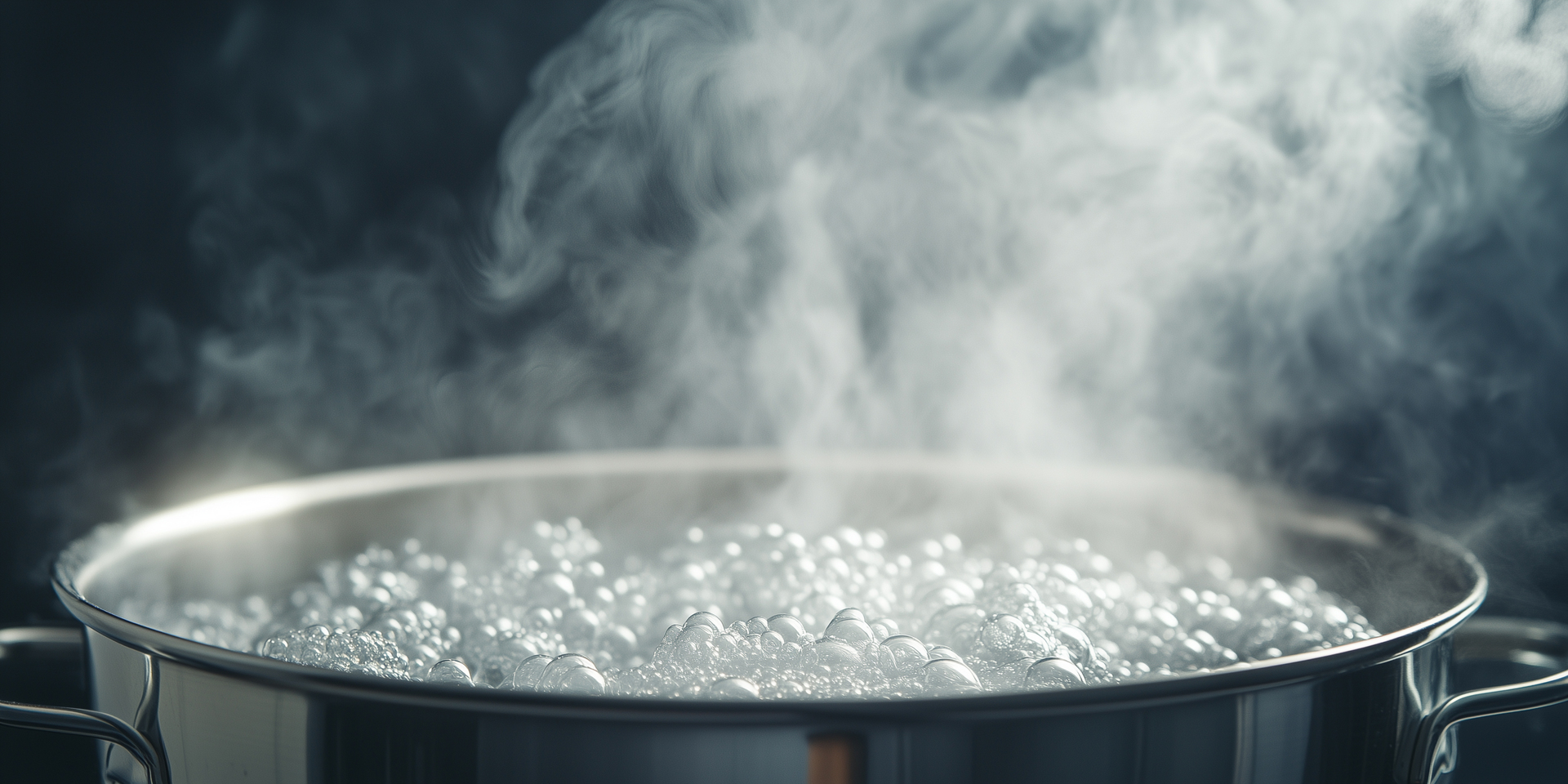
Under normal conditions, hagalah is simple: bring a pot of water to a full rolling boil, place the utensil inside for a few seconds (depending on thickness), ensure the water remains vigorously boiling while the utensil is submerged, then remove and immediately rinse with cold water.
How Hot Must the Water Be?
The Shulchan Oruch (O”C 452:1) defines the required heat simply as “ עד שירתיחו המים ”—until the water boils. The Shulchan Oruch HaRav (O”C 452:3) clarifies that this means bubbling, and the Mishnah Berurah (שם סק״ח) echoes this as well.
In the era of Chazal, a pot that reached a visibly strong rolling boil was considered to have attained the state of reticha required for kashering. With modern industrial food production—sealed systems, long piping networks, and large-scale equipment—a practical question arises: if the water cannot be seen, and operators rely on temperature gauges, what temperature qualifies as “boiling” for hagalah?
Three Halachic Approaches
1. FULL VIGOROUS BOIL (NEAR 212°F)
The strictest view requires a full rolling boil, with continuous, vigorous bubbling across the entire surface.
At this point, the water has reached its maximum natural temperature. At sea level, this occurs at approximately 212°F, when water rapidly begins converting to steam.
2. LAYER OF STEAM (190–200°F)
Some Poskim cite an oral psak attributed to Rav Moshe Feinstein that hagalah is valid once a visible layer of steam forms above the water. Attempts to define this point experimentally have produced differing conclusions: some place it at approximately 190°F, while others maintain it is only reliable closer to 200°F. According to this view, if 212°F cannot be reached, water within this range may still be considered as “boiling” for hagalah.
3. TEMPERATURE OF ABSORPTION (k’bolo kach polto)
A third view maintains that since kashering must mirror the manner of absorption, it is sufficient to heat the water to a temperature slightly higher than that at which the utensil absorbed. For example, if absorption occurred at 165°F, kashering at approximately 170°F would suffice.
This approach, however, is questionable. The principle of k’bolo kach polto is typically used by Chazal only to determine the method of kashering—whether libun or hagalah is required—not to establish the temperature of the water used for hagalah. Extending this rule to define the required heat level is a chiddush without a clear source. Some kashrus agencies rely on this approach in cases where higher temperatures are not achievable.
The OK Policy
OK Kosher policy follows the strictest opinion: hagalah must be performed with water at approximately 212°F.
Kashering at High Altitudes
The requirement of 212°F applies at sea level. At higher elevations, reduced atmospheric pressure causes water to boil at lower temperatures.
Accordingly, at facilities located at high altitude, the required temperature for hagalah is the local boiling point.
This is not a leniency, but a matter of physics. Water at high altitude cannot reach 212°F; it turns to steam at a lower temperature. Thus, if the maximum achievable boil is, for example, 190°F, performing hagalah at 190°F is halachically equivalent to 212°F at sea level. It represents the highest possible boil, and no further action is required.