 EN
EN  ZH
ZH  KR
KR  BR
BR  ES
ES  IN
IN  IL
IL  JP
JP 
Published:
December 12, 2025
Author:
Rabbi Osher Gutnick
Reading time:
12 minutes
Approximately two thousand years ago, during the times of the Mishnah, Chazal instituted a decree forbidding the consumption of certain foods cooked by Gentiles, known as bishul akum.¹ This decree was established for the purpose of preventing intermarriage,² and, according to some opinions, to protect us from mistakenly eating non-kosher food.³
The prohibition of bishul akum applies only to foods that meet both of the following criteria:4
Eino ne’echal k’mo shehu chai – not eaten raw. Foods that are consumed without cooking (under normal circumstances5, by a majority of people6) are not subject to the prohibition. Bishul Yisroel is only necessary when the act of cooking is significant enough to transform a previously inedible food into something fit for consumption.7
Oleh al shulchan melochim – suitable to be served on a royal table. Foods included in this category are those that one would typically invite an honored guest to partake in. Casual foods or snacks, by contrast, are not subject to the prohibition because they are less likely to lead to socialization.8
There is much debate among halachic authorities over which particular foods are eino ne’echal k’mo shehu chai and oleh al shulchan melochim. In this article we will explore whether chocolate falls into either of these categories.
The Production Process
A brief overview of the production process is vital in understanding how and why chocolate may require bishul Yisroel.
Production begins with the seeds of the cacao fruit, also known as cocoa beans. Each bean is surrounded by a sweet-tasting pulp, which is edible raw and has a sweet fruity flavor. The bean itself, which is the main component used for chocolate production, is quite bitter; it does not resemble chocolate and is generally not eaten in its natural state.
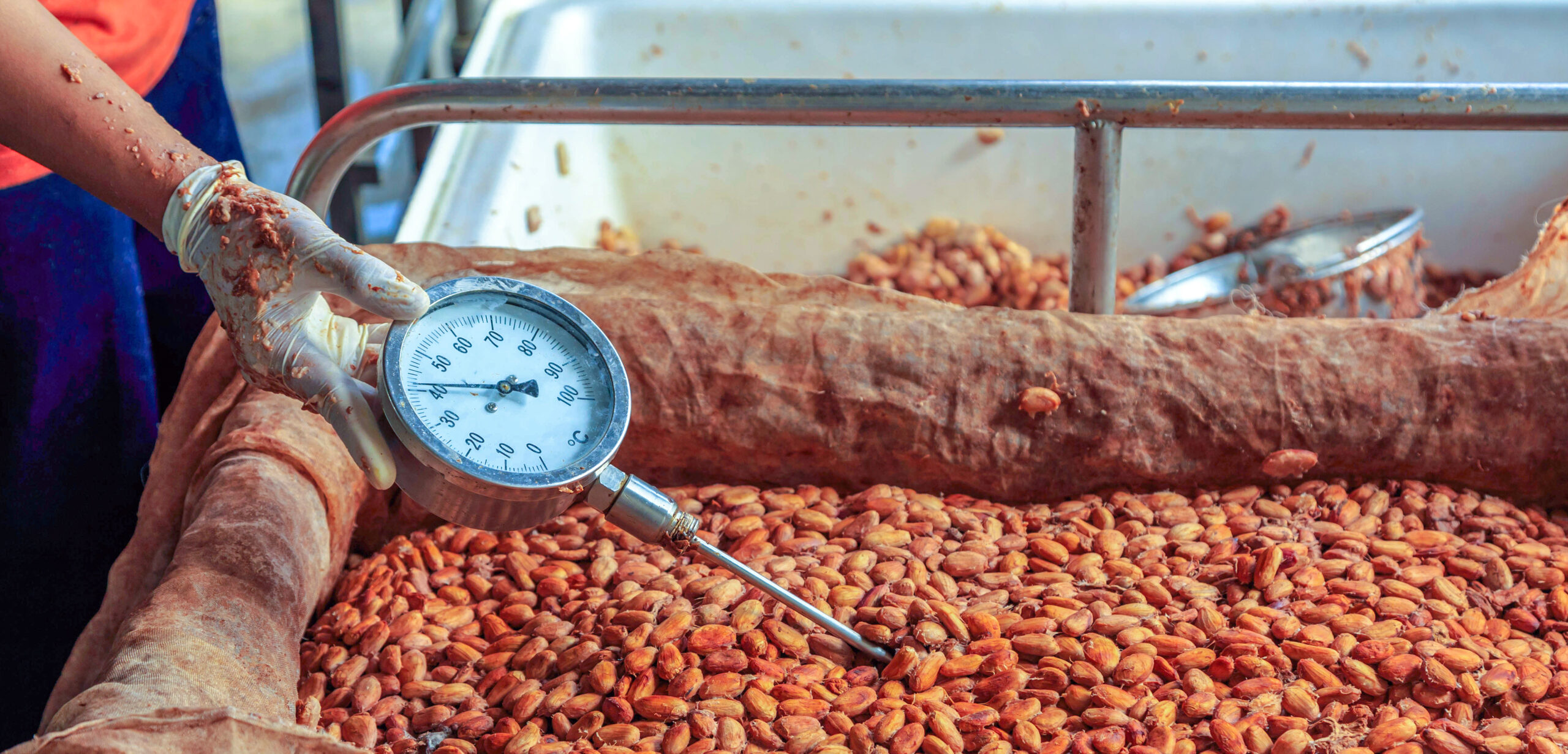
The beans are typically harvested by hand and gathered into piles, then left covered for several days to ferment in their own pulp. Naturally occurring microorganisms react with the pulp during fermentation, giving the beans a chocolate-like flavor. During this reaction, the temperature of the beans can reach up to 116°F. Despite being near the threshold of yad soledes bo (halachic cooking temperature), the fermentation is not considered “cooking” in the context of bishul akum as it does not involve the use of a fire or similar primary heat source. Heat generated by alternative methods, such as fermentation or melicha (salting), was not included in the rabbinic decree of bishul akum.9
Following fermentation, the beans are dried and roasted. Roasting gives the beans a fuller chocolate flavor.10
The beans are de-shelled and broken down into smaller segments called nibs, which are then ground into a paste called cocoa mass (also known as cocoa liquor).
Cocoa mass may be used as an ingredient for chocolate production (see below) or separated into two components: cocoa butter and cocoa cake. Cocoa cake is milled into cocoa powder, which is used as an ingredient in drinking chocolate (i.e., hot cocoa) or solid chocolate (i.e., chocolate bars). Cocoa butter is used as an ingredient in solid chocolate; it gives the chocolate its buttery consistency, allowing it to be solid at room temperature, yet easily melted.
To produce solid chocolate, the cocoa powder, cocoa butter, and/or cocoa mass are typically mixed with sugar (or an alternative sweetener) and then “squeezed” through a series of fast-spinning rollers to break down the particles. This is known as the refining step.
To produce milk chocolate and white chocolate, dried milk is added to the recipe. To produce white chocolate, cocoa powder and cocoa mass are omitted.
The mixture is then transferred to a specialized blending tank called a conche, which agitates and further breaks down the components over a period of several hours (or days). This process, known as “conching,” results in a smooth-textured, liquid chocolate. Lecithin (to help bind the ingredients together) and vanillin (to improve taste) are usually added to the recipe at this point. Additional cocoa butter may also be used to improve liquidity.
Significant heat can be generated by friction during the conching process, with temperatures often exceeding yad soledes bo. The heat keeps the chocolate in a liquid state, allowing the particles to be blended and broken down more easily, while also evaporating unwanted moisture. Like the heat generated during fermentation (above), the heat generated by friction does not pose a bishul akum concern.11
After conching, the liquid chocolate undergoes a process called tempering, wherein it is cooled and warmed again under low heat to promote the formation of stable cocoa butter crystals. This gives the chocolate a smooth surface and allows it to break cleanly when cooled into solid form. While still warm, the chocolate is poured and molded into its desired final shape (chips, squares, bars, and so on).
In summary, while chocolate and its ingredients are heated and warmed at various stages of production, the main concern of bishul akum arises from the fact that the cocoa beans are roasted during the process. Roasting is a form of cooking using conventional heat, which (when performed by a Gentile) may render the product forbidden.
When only one component of a product is inedible raw
The Shulchan Oruch rules that when multiple ingredients – edible raw and inedible raw – are mixed into a product and subsequently cooked by a Gentile, we follow the ikkar – the main ingredient – in determining its status. If the main ingredient is edible raw, the product is permitted.12 Based on this ruling, one may be inclined to argue that chocolate is not subject to bishul akum because the cocoa bean component has been mixed with other ingredients to the point where it is no longer the ikkar. However, unlike in the Shulchan Oruch’s case, the cocoa beans are roasted before being mixed with other ingredients, not after. What is the halacha then?
The Pri Chodosh’s Ruling
The first Posek who appears to address this question is the Pri Chodosh, who rules that drinking chocolate has the same status as coffee, which is permitted because the bean component is botul – nullified in the water13 (or the milk) with which it is made. The Pri Chodosh lived over three hundred years ago (during the 17th century), just as chocolate was starting to gain popularity across Europe. In that era, chocolate was almost exclusively consumed as a hot beverage, typically made by mixing cocoa mass (ground roasted cocoa beans) and hot water, with the possible addition of sweeteners and spices for taste.
Although the Pri Chodosh’s ruling was in reference to drinking chocolate, it may also apply to other forms of chocolate where cocoa is not the main component, such as white chocolate.14 (The main component of white chocolate is usually sugar, which is not subject to bishul akum.15) However, in other popular forms of chocolate, such as dark or bittersweet chocolate, the main component may be cocoa,16 which brings us back to our question.
Can chocolate be eaten raw?
The Chasam Sofer takes a different approach to the Pri Chodosh and draws a halachic distinction between coffee and chocolate: while coffee is permitted because the bean component is botul in the finished product, chocolate17 is permitted because it can be eaten “as is”.18 The Chasam Sofer apparently holds that cocoa – the basis for both drinking chocolate and solid chocolate – is edible raw and therefore not subject to bishul akum.19
It should be noted that there are a number of companies today producing “raw chocolate”. Although this product currently has no legal definition in the United States, manufacturers declare that the ingredients do not exceed 118°F during the manufacturing process. The cocoa beans are fermented and dried, but not roasted.20 Raw cocoa beans, nibs and powder (marketed as “cacao”) are also sold by retailers for use in smoothies and other food applications. Although such products may not taste quite the same as conventional cocoa or chocolate, their presence in the marketplace seems to support the Chasam Sofer’s notion that chocolate is eaten raw.
Roasting after fermentation
Whether or not the cocoa beans are roasted during the chocolate-making process, they typically undergo a fermentation step after harvesting (as above). Fermentation is essential in developing the bean for consumption and significantly changes its taste in a way that roasting alone cannot. The Shulchan Oruch rules that food made edible by salting (by a Jew or a Gentile) and then cooked by a Gentile is not subject to the prohibition of bishul akum.21 This is because the initial salting step is not considered an act of cooking vis-a-viz bishul akum (as explained above), and the subsequent roasting by the Gentile is of no halachic significance because the food was already edible beforehand.22 Poskim also apply this concept to foods that have been made edible by soaking (kovush) or cold-smoking prior to cooking.23 We may therefore infer that if cocoa beans undergo fermentation (a form of soaking), which makes them edible without subsequent roasting, then they do not become forbidden if roasted by a Gentile.
Is chocolate really fit for a royal table?
Chocolate bars and truffles can be enjoyed on their own as a snack, or perhaps as a dessert at the end of a meal. Some chocolates are elaborately decorated and may be considered a fancy food; indeed, a box of chocolates is commonly considered a fitting gift for special occasions.
Nevertheless, contemporary Poskim have ruled that chocolate falls into the same category as sweets and other confectioneries which are not distinguished enough to require bishul Yisroel.24 Some Poskim appear to leave open the possibility that chocolate may be suitable for a royal table, but still support the custom to permit it because it is usually eaten on its own, rather than as part of a meal.25
When cooking alone doesn’t make the food fit for a royal table
Even if we do consider some chocolates to be fit for a royal table, the roasting of the bean alone certainly does not result in a product that is fit for a royal table.26 The beans (or nibs) must undergo major changes after roasting, including a lengthy refining process, significantly altering their taste and form. Some Poskim cite this reasoning to permit sugar and refined vegetable oil, which also require significant changes subsequent to their initial cooking or roasting steps to be considered oleh al shulchan melochim, and the same logic may be applied to chocolate, thereby providing an additional factor to be lenient.27
In conclusion, we see that chocolate truly has no parallel in the culinary world. It is not quite like coffee, candy, vegetable oil, or cooked fruit, although it shares halachic commonalities with all of these and more. Given the factors discussed above, the view of the OK and other mainstream kosher agencies is that all forms of chocolate – including cocoa powder, baking chocolate, drinking chocolate, chocolate coins, and even fancy chocolate – do not require bishul Yisroel.28 Let us thank Hashem for this wonderful treat He has given us.
ראה עבודה זרה ל”ז:, שו”ע יו”ד סי’ קי”ג 1
רש”י ע”ז ל”ה:, תוס’ שם ל”ח., טור סי’ קי”ב 2
רש”י שם ל”ח. וראה ערוך השלחן קי”ג ס”ב 3
שו”ע שם 4
ראה שו”ע שם י”ב )דעה א( ורמ”א שם, שדבר שנאכל חי רק ע”י הדחק אסור 5
ראה סולת למנחה כלל ע”ה דין ט”ז דאם אדם אחד אכלו חי בטלה דעתו אצל כל אדם. וכן נפסק 6
.בכמה אחרונים
ע”פ רש”י ביצה ט”ז. ד”ה אין, “דכיון שנאכל כמו שהוא חי אינו בשול דלא אהני מידי 7
ע”פ רמב”ם הל’ מאכלות אסורות פ’ י”ז הל’ ט”ו, דאין דרך האדם לזמן את חבירו עבור מאכל שאינו 8
.חשוב
ראה שו”ע ורמ”א שם י”ג 9
10 Due to their naturally high acidity, the cocoa may also be mixed with an alkalizing agent (commonly potassium carbonate). Although not essential to make edible cocoa, it results in a milder tasting, darker-colored product known as Dutch-processed cocoa, which is sometimes
preferred over natural (non-alkalized) cocoa.
11 Some chocolate manufacturers may add a small amount of conventional heat to the conche if the heat generated by friction is deemed insufficient to create a fluid mixture. In most cases, however, the conche requires cooling to limit the heat generated by friction, as
excessive heat tends to ruin the taste of chocolate.
שו”ע יו”ד סימן קי”ג ב 12
13 פרי חדש יו”ד קי”ד ס”ק ו’: “מותר לשתות הקא”וי בבית העכו”ם… יש להתיר מין משקה אחר שנקרא גיקולאט”י בלעז.” ומסביר שם דכשם שבטל הפרי לגבי המים לענין ברכה כך הוא בטל לענין
(בישול עכו”ם. ועוד טעם נתן להיתר, שרובא דעלמא שותין אותם בלא ליפות פת, ולשיטתו דבר שאינו עשוי ללפת בו את הפת אין בו משום בישול עכו”ם אע”פ שעולה על שלחן מלכים ואינו נאכל חי, .(ע”ש
14 White chocolate contains cocoa butter but does not contain cocoa powder nor cocoa mass. It is notable that prior to 2002, the FDA defined white chocolate as “confectionary” because it did not meet the legal definition of chocolate for this reason.
15 ראה פסקים ותשובות סי’ קי”ג הערות 38 ו 76-
ואעפ”כ, מנהג העולם הוא לברך שהכל נהיה בדברו על כל מיני שוקולד. וראה שו”ת שבט הלוי 16
.או”ח סימן כ”ו
17 The Chasam Sofer is referring to drinking chocolate (like the Pri Chodosh) as opposed to solid chocolate, given the context of his ruling regarding coffee. By some historical accounts, solid chocolate was already beginning to gain popularity in Europe during Chasam Sofer’s
lifetime (5523-5600/1762-1839); nevertheless, it was still more common to consume it as a beverage. The solid chocolate in those days would have been quite crude compared to the smooth-textured chocolate of today, which was only invented after the discovery of the conching process in 5639/1879.
חידושי חתם סופר ע”ז ל”א: “ושאקילאט”ע פשוט דנאכל כמות שהוא ומותר”, משא”כ קפה שהתיר 18
מטעם שבטל לגבי המים )ודלא כתשובת מהר”ם א”ש )נדפס בשו”ת פנים מאירות ח”ב סי’ ס”ב( שראוי
(.לבעל נפש להחמיר בקפה, ע”ש
ראה גם תשובות מהרש”ם חלק ב’ סי’ רס”ב: “בטשיקילאדע ליכא איסור שהרי נאכל חי.” )ומוסיף 19
שם: “ונודע כי הטשיקילאדע בזמן הזה יש בה חשש תערובות איסור ואין לאכלה ולשתותה בלא הכשר
(”.מרב ירא שמים
20 The stated purpose of omitting the roasting step is to preserve the nutritional value and health benefits of the cocoa beans.
שו”ע שם י”ב: “דגים קטנים שמלחן ישראל או גוי הרי הן כמו שנתבשלו מקצת בישול ואם צלאן גוי 21
.אחר כן מותרים.” וי”ל שזה דומה לעניננו, דכשצולים את הקקאו הצלי’ היא אחרי כבישה
ולהעיר שאחרי המליחה צ”ל נאכל לרוב בני אדם ולא ע”י הדחק, כדין דבר שנאכל כמו שהוא חי 22
כנ”ל וכדעה הראשונה בשו”ע שם שאוסרת דגים מלוחים גדולים שאינם נאכלים אלא ע”י הדחק, וכן
.נפסק בערוך השלחן יו”ד סי’ קי”ג כ”ה-כ”ו ובעוד אחרונים
ראה פסקים ותשובות שם כ”ו, וטעם לדבר שגם כבישה ועישון קר אינם נחשבים כבישול לענין 23
.”בישול עכו”ם, כמבואר בשו”ע שם י”ג, וממילא המאכלים נחשבים כ”נאכל חי
תשובות והנהגות ח”א סי’ תל”ח: “בשוקלדה נראה שאין איסור בישול עכו”ם, וטעם הדבר שאין 24
איסור אלא במאכל חשוב העולה על שולחן מלכים שחשוב ביותר. אבל מה שאין אוכלים אלא עראי
.”להנאת הטעם ולא בתוך הסעודה דומה לתה וקפה ומשקה שוקולדה שנהגו שאין בהם בישול עכו”ם
ראה הערה הקודמת, וראה קובץ מבית לוי גליון ח’ עמ’ מ’ בשם הגר”ש וואזנר, שיש להקל כיון שאינו 25
.אכילת סעודה ולא פרפרת רק טעימת ארעי
בענין זה דומה לאבקת קפה קלוי, שעליו כתוב בכף החיים יו”ד סי’ קי”ג ס”ק כ”ג דלא נאסרה משום 26
.”בישול עכו”ם “דהא קלוייה אינה עולה לא על שלחן מלכים ולא על שלחן הדיוטות
ראה שו”ת שואל ומשיב סי’ ר”ל שהתיר סוכר דאחרי הבישול צריך זיקוק וקישוי כדי להעלותו 27
על שלחן מלכים. וכן נמצא בשו”ת בית שלמה יו”ד ח”א סי’ קע”ח לגבי שמן צמחי שנעשה מגרעינים
מבושלים. נראה מדבריהם שצ”ל תיקון גדול במאכל שמביא למציאות חדשה, משא”כ בתיקון קטן כגון
.הוספת תבלינים או שאר חומרי גלם בלבד, יש לאסור. ראה שו”ת חסד לאברהם יו”ד סי’ ח
בתשובות והנהגות ח”ה סימן רמ”ט אות ה’ כתב שטוב עדיף שישראל יוסיף פעולה בבישול, אך 28
.נראה מדבריו שמותר בלאו הכי כיון שאינו עולה על שולחן מלכים בסעודה, ע”ש